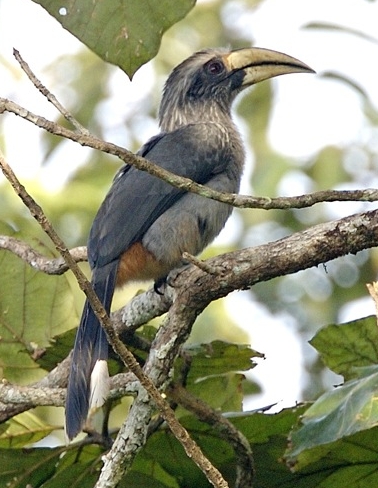
Great Hornbill
Buceros bicornis
- Length
- 95–130 cm
- Family
- Hornbills (Bucerotidae)
- Order
- Bucerotiformes
Overview
The great hornbill (Buceros bicornis), also known as the concave-casqued hornbill, great Indian hornbill or great pied hornbill, is one of the larger members of the hornbill family. It occurs in the Indian subcontinent and Southeast Asia. It is predominantly frugivorous, but also preys on small mammals, reptiles, and birds. It has been listed as Vulnerable on the IUCN Red List since 2018. It is known to have lived for nearly 50 years in captivity.
Summary from Wikipedia, available under CC BY-SA 4.0.
Diet: Mainly figs and other fruit, plus small animals.
How to identify it
- Huge black-and-white hornbill with a yellow, U-shaped casque on top of the bill
- White neck and broad white bands across the black wings and tail
- Loud whooshing wingbeats audible from far away
Voice
Deep barking calls often given as a duet.
Where to see it
- Kaeng Krachan, Thailand
- Western Ghats, India
- Eaglenest, India
Destination guides featuring this bird

- JJanuary: Good
- FFebruary: Best
- MMarch: Best
- AApril: Best
- MMay: Poor or no data
- JJune: Poor or no data
- JJuly: Poor or no data
- AAugust: Poor or no data
- SSeptember: Poor or no data
- OOctober: Good
- NNovember: Good
- DDecember: Good

- JJanuary: Best
- FFebruary: Best
- MMarch: Best
- AApril: Best
- MMay: Poor or no data
- JJune: Poor or no data
- JJuly: Poor or no data
- AAugust: Poor or no data
- SSeptember: Poor or no data
- OOctober: Poor or no data
- NNovember: Good
- DDecember: Good
Similar species
- Rhinoceros Hornbill
- red-and-yellow upturned casque, Borneo and the Malay Peninsula
- Oriental Pied Hornbill
- much smaller, black-and-white casque
Range and habitat
Lowlands of India to southwestern China, southeastern Asia, and Sumatra.
Range description: AviList Global Avian Checklist.
Sources and further reading
- Wikipedia: Great hornbill
- eBird: sightings, maps and photos
- xeno-canto: sound recordings
- Birds of the World: full species account (subscription)
- BirdLife DataZone: status and threats
- IUCN Red List (threat status)
- AviList global checklist (taxonomy)
Last updated September 29, 2026.