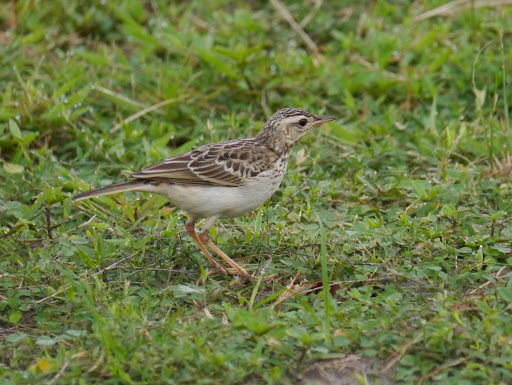
Tawny Pipit
Anthus campestris
- Family
- Wagtails and Pipits (Motacillidae)
- Order
- Passeriformes
Overview
The tawny pipit (Anthus campestris) is a medium-large passerine bird which breeds in much of the central Palearctic from northwest Africa and Portugal to Central Siberia and on to Inner Mongolia. It is a migrant moving in winter to tropical Africa and the Indian subcontinent.
Summary from Wikipedia, available under CC BY-SA 4.0.
Range and habitat
Breeds central and southern Europe and northwestern Africa (Morocco eastward to Tunisia) eastward to northwestern and south-central Mongolia, northwestern Kazakhstan, northern Afghanistan, and far northwestern China, also locally in Middle East; winters in sub-Saharan Africa (mainly in the Sahel), Arabia, and southwestern Asia.
Range description: AviList Global Avian Checklist.
Countries
- Afghanistan
- Albania
- Algeria
- Andorra
- Armenia
- Austria
- Azerbaijan
- Bahrain
- Bangladesh
- Belarus
- Belgium
- Benin
- Bosnia and Herzegovina
- Bulgaria
- Burkina Faso
- Chad
- China
- Croatia
- Cyprus
- Czechia
- Denmark
- Djibouti
- Egypt
- Eritrea
- Estonia
- Ethiopia
- Finland
- Gabon
- Gambia
- Georgia
- Germany
- Ghana
- Greece
- Guinea
- Guinea-Bissau
- Hungary
- India
- Iran
- Iraq
- Ireland
- Israel
- Italy
- Jordan
- Kazakhstan
- Kenya
- Kosovo
- Kyrgyzstan
- Latvia
- Lebanon
- Liberia
- Libya
- Liechtenstein
- Lithuania
- Luxembourg
- Mali
- Malta
- Mauritania
- Moldova
- Monaco
- Mongolia
- Montenegro
- Morocco
- Netherlands
- Niger
- Nigeria
- North Macedonia
- Oman
- Pakistan
- Palestine
- Poland
- Romania
- Russia
- San Marino
- Saudi Arabia
- Senegal
- Serbia
- Slovakia
- Slovenia
- Somalia
- Spain
- Sudan
- Sweden
- Switzerland
- Syria
- Tajikistan
- Tunisia
- Turkey
- Turkmenistan
- Ukraine
- United Arab Emirates
- Uzbekistan
- Vatican City
- Western Sahara
- Yemen
Sources and further reading
- Wikipedia: Tawny pipit
- eBird: sightings, maps and photos
- xeno-canto: sound recordings
- Birds of the World: full species account (subscription)
- BirdLife DataZone: status and threats
- IUCN Red List (threat status)
- AviList global checklist (taxonomy)
Last updated September 29, 2026.